[115] Books Reviewed
by author:

Showing posts with label memoir. Show all posts

Monday, October 11, 2010

A Wolf at the Table: A Memoir of my Father by Augusten Burroughs

() I'm usually an enthusiastic Burroughs reader, but this book was a thorough disappointment.

I trudged a little over halfway through the book until I finally let myself stop. Avoiding a book simply for the content is not okay. Yet I still pushed forward since this is by Augusten Burroughs. But as I said, I came to the conclusion that this was just not worth my time.

It's a basically a big whine about his father, and more sob stories of his adolescence. Yeah, there's a lot of comedy mixed in. Too bad it's not enough to save this load of profit-inspired garbage.

Sorry Burroughs. I'm not quite the fan I used to be.

Tuesday, September 7, 2010

The Birthday Party: A Memoir of Survival by Stanley N. Alpert

() The plot of this memoir is unique: the author is kidnapped and held for over 24 hours, including on his birthday. He is robbed and "psychologically tortured," but then let go. The book details this account as well as the later prosecution of the criminals involved.

The abduction seemed completely spur of the moment, a random act committed in the process of their "usual" patterned muggings. They took Alpert, an environmental advocacy attorney, and kept him hostage while they continued to use his bank cards to withdraw mass amounts of money from his accounts. They were armed, but weren't your usual cruel, violent kidnappers. They offered Alpert food, and even a 'blow job' from one of the prostitutes that were present.

Their culture was completely alien to Alpert. He had never been exposed to individuals who smoked weed everyday, turned 'tricks' for money, and committed sex acts in the presence of others with no second thought. Crime to these people was common place, almost necessary. But their humanity was undeniable; they cared about him. They even offered Alpert $20 to catch a cab when they let him go.

It's interesting, sure, but the second half of the book can drag on with details, especially about the case and trial. This didn't seem really necessary and puts a damper on the book.

Thursday, August 26, 2010

Thin is the New Happy by Valerie Frankel

() The author, like many modern women, struggles greatly with body image. She describes her woes of self-acceptance and dealing with others' harsh opinions. At a very young age, her mom has her start dieting because she is bigger than her siblings. Ever since that time, she always has a restricted food intake habit of some kind or another. She becomes addicted, and admits to feeling lost without being on a diet.

But as she grows older and learns from various relationships and life experiences, she also learns that her bad body image issues need to be dealt with. She works on changing her thought processes and behaviors, and soon begins maintaining a more stable weight and life. She publishes an article about current female body image difficulties in SELF magazine. Accompanying this are sexy "nude" photographs from a shoot she schedules for herself.

It's a good memoir to learn from and definitely brings insight into the problems of 'ideal' pressures. Good for any woman struggling with her own body acceptance.

Monday, August 16, 2010

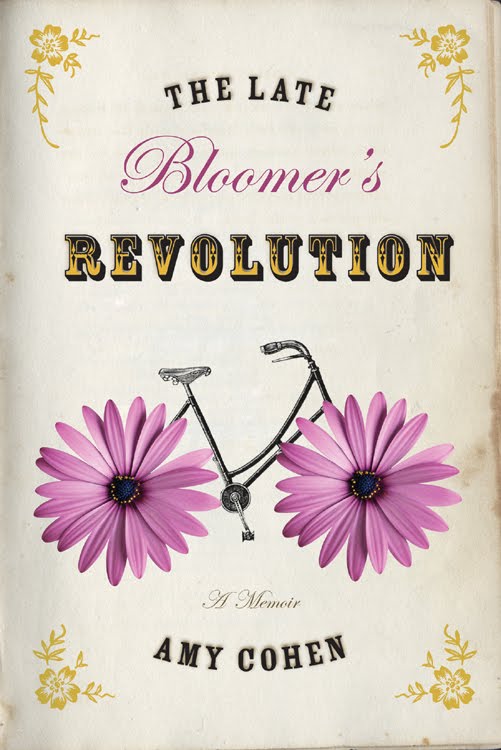
The Late Bloomer's Revolution by Amy Cohen

() Exquisitely creative writing style. The metaphors and language is brilliant. "I saw myself as the emotional equivalent of a cheap piñata, one hard blow and that would be it."

Follows a woman through her strings on failed relationships and desperation for companionship. Then, finally, in her late thirties, she gains her own independence and strength. She finally learns how to ride a bike. (Which is something I still cannot even do.) She learns how to dump her fiancee without much grief. She learns the importance of her own, self-made happiness. She wants, but does not need any man. She won't settle or compromise for less than she deserves.

Empowering, especially to an older generation. (I'm in my early twenties but still found it inspirational.) It's never too late to be who you always wanted to be.

“If it’s not too late to learn to ride a bicycle, maybe it’s not too late to start growing up.”

Saturday, August 7, 2010

Hurry Down Sunshine: A Memoir by Michael Greenberg

() This story is told through the eyes of a father whose daughter is struck with psychosis. Her episode occurs at the early onset of age 15. She is tentatively given the label of 'Bipolar I', but doctors think it is still too soon in her life to serve a definitive diagnosis.

The author is very skilled at examining his daughter's behaviors. "She thinks she's eloquent, when she can't put together a cohesive sentence. She demands control because, in some interstice of her psyche, she knows she is hurtling out of control." (pg ?) His explanations of his perspectives are so precise that they can seem somewhat pompous - though maybe that was just the vibe I got from the voice on the audio book, and not necessarily the writing itself.

It's an interesting read for anyone fixated on mental disorders, like me, a psych major. Otherwise, it can be a bit tedious with its detail.

"I know how they talk, especially about girls. There's no mercy. They'll snicker about her and crack jokes. We have to keep this from getting out [...]" (pg. ?)
"She won't be doing the Thorazine shuffle, if that's what you mean. But will she be the most normal-looking person on the A train? Probably not [...]" (pg. ?)

Thursday, July 29, 2010

Fish: A Memoir of a Boy in a Man's Prison by T.J. Parsell

() I love the honesty shown in this book. A lot can be learned through the trauma that the author experienced. However, there were an incredible amount of typos, and some of the writing just seemed rushed. But this was definitely a suspenseful, thrilling novel. And again, even more intense since it's true. It sheds light on important problems (and strengths) inside our correctional system. The author is now a human rights advocate for ending sexual abuse in detention centers.

Basically, at 17, Parsell is given a disproportionate sentencing for his "joke" of a crime: robbing a Photo Mat with a toy gun. He is sent to various facilities, where he is continually raped and abused. He describes needing a "man" in order to protect himself from further rape, and the fear and distrust that built up and stayed with him long after he served his time. It was really interesting to hear about the incarcerated culture and psychological games everyone plays in order to maintain the social structure on the inside. Some of it is barbaric, but some of is very calculated. A lot of prisoners may not be very educated, but that doesn't make them stupid.

The author grows from the experience. He becomes sure of his sexuality and his strengths/weaknesses. He even finds his first love in jail. It's a good story, but not quite at the level of the memoirs I read before it.

"I was beginning to feel like a regular Houdini. But it was Houdini at the very end, in the movie version, where he was trapped inside a tank and everyone looked on, no one could see he was drowning." (pg. 40)
"I[f] you ever want to know what time it is about someone, or something, all you have to do is Telephone, Telegraph, or Tell and Inmate." (pg. 47)
"My dad once told me, to never trust a guy who'll tell on himself. Because if he does that - he'll tell on anybody." (pg. 156)
"My guidance counselor said it didn't matter, which was easy for him to say, since his life was practically over to my thinking. If a kid sat where he didn't belong; or if someone tried to climb too high - [t]he kids at the top were never shy about smacking him back into place." (pg. 182)
"now that I was getting an education I was starting to understand what it meant not to have one. I wondered how different I might have turned out had I paid attention to some of these lessons earlier - but how could I if I only lived in one world that didn't value learning? And would I have been ready to listen?" (pg. 254)
"When I had shut down over the years, I had blocked out anything that hurt me or might have hurt me. At the same time, in doing so, I also locked something else in - stuffing it deep within myself. For a split second I caught a glimpse of who I truly was. It was such a brief simple moment - triggered by what that guard had said: 'You don't belong here.'" (pg. 306)
"teenagers in adult facilities are five times as likely to be sexually assaulted than young people housed in juvenile facilities, and eight times as likely to commit suicide. [...] Most people who want to be tough on crime don't care what happens to inmates. But they should care, because 95 percent of all prisoners are eventually released back into society, indelibly marked by the violence they have seen or experienced. Up until recently, corrections officers have not been doing enough to curb this violence." (pg. 321)

Monday, July 26, 2010

Picking Cotton: Our Memoir of Injustice and Redemption by Jennifer Thompson-Cannino, Ronald Cotton, and Erin Torneo

() Nothing is perfect. Not out justice system, and certainly not our memory. Our memory is especially unreliable in traumatic situations. This book illustrates this in a none-too-short story about a man named Ronald Cotton. He was wrongfully identified by a determined, eduring witness, and rape survivor, Jennifer Thompson.

The book switches from narrating both perspectives. Cotton spends 11 years incarcerated for a rape he never committed. Finally, DNA and another inmate's detailed confession clears him of the crime. Yet all that time, Jennifer Thompson was dead-sure it was Robert Cotton.

But she, Cotton, and the police department are soon educated by research that reveals current police practices can taint the mind of a witness. Thompson was guided to her conclusion, though it was also in line with her memory. (Ronald Cotton was often mistaken to be Bobby Poole, the real perpetrator, while in prison.) So technically, as it says somewhere in the book, they are all "victims of the same rapist." Thompson and Cotton eventually became close friends.

Even when we are completely certain of something, we can still be wrong. Our memories aren't static, though we like to think so. This is a non-fiction book authored by the main characters themselves. It's a good read.

But maybe I'm just growing a love for memoirs. I listened to this as an audio book.

"The way pipes burst when there's too much pressure - I couldn't allow that pressure to build up in me, because it'd snap my mind. I had to protect my mind, to get it in front of the time. [...] More waiting, carrying a big question mark over my head. if this was my life - if I was going to spend the rest of my days in a North Carolina prison - I had to figure out a way to live it." (pg. 144)
"Some of the nicest people you met in prison were sometimes the ones who had done the worst stuff. You never know who to believe. Some people told lies because they didn't want to accept what they had done. A couple of times I tried to tell people I didn't do it, but they usually just said, 'You had to, if you didn't do it, you wouldn't be here.'" (pg. 152)
"Put a man in a cage with beasts and throw away the key, and it's usually not very long before the man is a beast himself." (pg. 155)

Sunday, June 20, 2010

Wasted: A Memoir by Mark Johnson

() From being brought up in the ghetto to rape, murder, addiction, homelessness, and growth/recovery - this story covers it all. Pretty hard to believe this is a real account of someone's life. But sometimes truth really is stranger than fiction.

Mark Johnson was exposed to horrendous environments at a very young age. He started drug and alcohol use when he was just a child. He was also sexually assaulted and passed on the deed. Abused and confused, he created a tough persona which made him prone to addiction and crime. The reader is taken through Johnson's youth, jail time, drug struggles, and the peril of living on the streets.

But finally, with too many near-death experiences and threats on his life, he makes a longer-lasting attempt at change. Eventually, he is successfully rehabilitated. Unlike so many other addicts and ex-offenders, he is able to rebuild his life with the help of various people and organizations surrounding him. He starts his own business and tries to help others who are making an effort to improve their lives as well.

"Vanessa's soon saying she loves me. That's a license to treat her like shit. But I retreat into her arms whenever the mayhem I've caused gets too much even for me." (pg. 90)
"In jail we've learned to live on our wits, manipulate people and use violence and retaliation as a routine means of survival. And I have the Block to thank for making me an expert in brutality. What a great training ground Portland was for a life of crime: it's much easier now to do these things and not feel a qualm." (pg. 109)
"after a day and a night the party is so magical that I hate it. I wish the experience away because I know that it is going to change my life and not just change it but ruin it. And I know that this is my destiny and I have no choice." (pg. 127)
"I don't want to be this way. I hated myself for stealing from Kelly but I couldn't stop myself. Drugs have stripped away my flesh. Anything that's good and everything I've ever learned about how to behave is being lost, along with my humanity. What's left behind is hard and primitive and cares only for its own survival." (pg. 180)
"It hits me with a series of terrible photos of all I've said and done. It's like the biggest, worst hangover because I wasn't just drunk last night. I've been drunk my whole life." (pg. 261)
"I mean you've got to tell your secrets. Real secrets. All the small embarrassing things you've never told anyone, the sneaky things, the spiteful things, the grassing-up-your-mates keep-it-to-yourself kind of things that you swore you'd never tell a soul. [...] Talking about your weaknesses gives you back your power." (pg. 287)
All books reviewed can be obtained at the
Santa Clara County Library
Many of these reviews can also be found at Amazon.com